
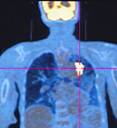
CT-PET scan fusion precisely localizes the tumor
Treatment of Lung Cancer
Lung cancer treatment depends on several factors, including the type and size of the cancer, its location, and your overall health. Typically, several different treatments and combinations of treatments will be used to combat lung cancer. During treatment, a team of doctors may be involved in your care, including a radiation oncologist, a medical oncologist and a surgeon.
Non-small cell lung cancer may be treated first with surgery. Your doctor may also suggest radiation therapy or chemotherapy either alone or in combination.
Small cell lung cancer is often treated with chemotherapy and radiation therapy either at the same time or one right after the other.
Understanding Radiation Therapy
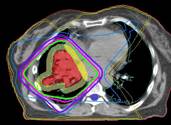
Radiation therapy, also called radiotherapy, is the careful use of radiation to safely and effectively treat cancer. Radiation therapy works within cancer cells by damaging their ability to multiply. When these cells die, the body naturally eliminates them. Healthy cells are also affected by radiation, but they are able to repair themselves in a way cancer cells cannot.
External Beam Radiation Therapy
External beam radiation therapy involves a series of daily radiation treatments targeting your lung tumor.
Radiation therapy treatments are delivered in a series of daily sessions. Each treatment itself is painless, simmilar to the xray and will last less than 30 minutes, Monday through Friday, for several weeks.
Linear Accelerator is typically utilized for external beam radiation therapy
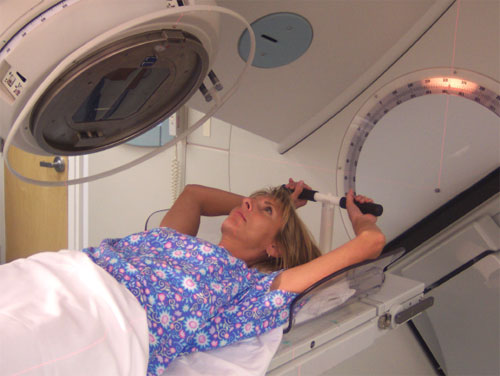
3-Dimensional Conformal Radiotherapy combines multiple radiation treatment fields to deliver precise doses of radiation to the lung tumor. Tailoring each of the radiation beams to accurately focus on the tumor targets the cancer while protecting nearby healthy tissue.
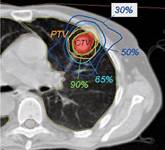

Intensity Modulated Radiation Therapy is a form of 3D-CRT that modifies the radiation by varying the intensity of each radiation beam. This technique allows a precise adjustment of radiation doses to the tissues within the target area, possibly allowing a higher radiation dose to the tumor and keeping more radiation away from nearby normal tissues. IMRT is still being studied for lung cancer.
Stereotactic Radiotherapy (sometimes called radiosurgery) is a novel external radiation technique reserved for small tumors in the lungs where high does radiation therapy is delivered in only 3 to 5 sessions. High precision of radiation is achieved with CT guidance.
Internal Radiation (Brachytherapy)
In some cases, your doctor may recommend brachytherapy which involves placing radioactive material into a tumor or its surrounding tissue during bronchoscopy.
Possible Side Effects
Side effects are different for everyone. Some patients feel fine during treatment while others may feel uncomfortable. Side effects are caused by the radiation beam passing through and damaging normal tissues and organs on its way to the tumor. The direction the beam travels through the body differs from patient to patient, and so their side effects may also be different. Different organs respond to radiation in different ways. Some become damaged relatively quickly, and you may experience the side effects within two to three weeks after starting your treatment. Other organs become damaged slowly, and you may experience side effect anywhere from six months to many years after the treatment is ends. Possible problems include skin irritation, difficulty or pain when swallowing, shortness of breath, and fatigue